77% of loyalty programs fail because they're discounts in disguise. Nudj Rewards uses the four principles that actually work — variable schedules, loss aversion, goal gradients, and the endowment effect. The same psychology that powers Starbucks, Sephora, and Amazon Prime.
The difference between a punch card and a loyalty program
77% of loyalty programs fail within two years. The ones that work — Starbucks, Sephora, Amazon Prime — all do the same four things. Nudj makes those four things the default, not the exception.
5.2× average ROI
92% redemption rate
306% higher customer lifetime value
Deploy in 48 hours
Four psychological principles behind loyalty
Starbucks doesn't win on coffee. Sephora doesn't win on products. They win on psychology.
Variable reward schedules — B.F. Skinner
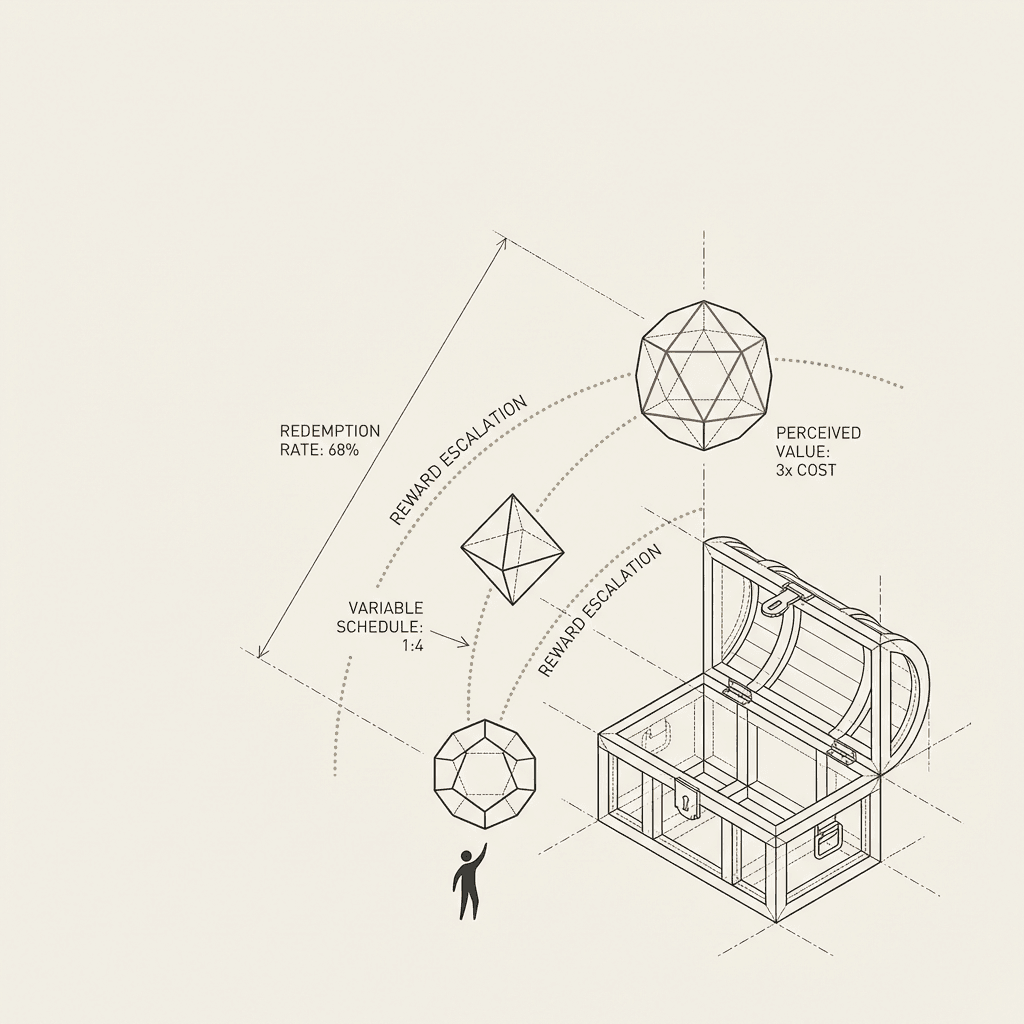
Unpredictable rewards create 400% higher dopamine than fixed rewards. Variable ratio schedules produce 'hard to extinguish' behaviors.
Implementation: prize draws, mystery boxes, random bonus multipliers, surprise campaigns. Outcome: 3-5× engagement vs. fixed rewards. Starbucks: 28.7M active members.
Loss aversion — Kahneman & Tversky, 1979
Losses are 2× more psychologically powerful than equivalent gains. Expiring points trigger fear of missing out.
Implementation: countdown timers, tier decay warnings, point expiration, time-limited offers. Outcome: 37% spending increase to maintain status. Sephora: 81% retention.
Goal gradient hypothesis — Clark Hull, 1932
Motivation accelerates as goals approach. Progress bars increase completion by 82%.
Implementation: progress bars, illusionary progress (start at 20%), milestone rewards. Outcome: LinkedIn 27% completion boost. Starbucks: increased frequency near reward.
Endowment effect — Richard Thaler, 1980
People value owned items 2-3× more. Accumulated points create sunk-cost commitment.
Implementation: visible point balances, possessive language, reward history, pre-awarded bonuses. Outcome: 2-3× perceived value. 85% more likely to continue after joining.
Reward features that drive loyalty
Every feature backed by behavioral psychology research.
Three reward types — instant rewards for gratification, prize draws for high-value wins, badges for achievement recognition. Variable rewards + social proof + status.
Tiered systems — Bronze/Silver/Gold/Platinum with exclusive rewards, tier decay warnings, and progress tracking. Status + loss aversion + goal gradient.
Automated prize draws — fair, transparent winner selection with unpredictable timing that triggers dopamine spikes. Variable ratio reinforcement.
Smart inventory — unlimited or limited supply, per-user limits, stock tracking, and expiration management. Loss aversion + scarcity.
Experiential rewards — beyond points: exclusive access, VIP experiences, early releases, community events. Peak-end rule + social identity.
Instant vs. delayed — immediate rewards for instant dopamine, delayed high-value rewards for anticipation building. Hyperbolic discounting + dopamine.
Why it matters
No credit card required to start. No six-month rollout. The same behavioral psychology that powers Starbucks, Sephora, and Amazon Prime — turned into a drop-in loyalty layer for any website.