
The Referral Paradox: Why Asking Customers to Share Kills 67% of Virality
You've built a referral program. You've added social sharing buttons. You're literally asking customers to "tell their friends." And yet, your viral coefficient sits at 0.15 while competitors somehow achieved Dropbox-level growth (k-factor of 0.7+). What's going wrong?
Welcome to the Referral Paradox: 83% of customers report being willing to refer friends to brands they love, but only 29% actually follow through. That's a staggering 54-percentage-point gap between intention and action—and it's costing you millions in customer acquisition costs.
The irony? The very act of asking customers to share is what kills virality. Research from Wharton professor Jonah Berger reveals that explicit "share this" requests trigger psychological resistance, transforming what should be organic word-of-mouth into a transactional obligation. Meanwhile, customer acquisition costs have inflated 60% over the past five years, with median SaaS CAC payback periods now stretching to 23 months. Organic growth isn't just nice-to-have anymore—it's survival.
The solution isn't to ask harder or offer bigger incentives. It's to design systems that make sharing feel inevitable, valuable, and emotionally rewarding. Enter STEPPS: Jonah Berger's framework for contagious content that drives word-of-mouth marketing with a documented $6.50 return per dollar spent—far outperforming traditional paid advertising.
In this deep dive, we'll dissect why referral programs fail, unpack the STEPPS framework with proven case studies (Dropbox's 3,900% growth, Morning Brew's 3M subscriber base), and provide an implementation blueprint for building viral loops that actually work. By the end, you'll understand why the best referral programs never ask for referrals at all.
the referral paradox explained: why good intentions don't convert
Let's start with the brutal math. Texas Tech University research found that while 83% of satisfied customers express willingness to refer friends, a mere 29% actually take action. That's not a small conversion gap—it's a 54-point chasm that separates marketing fantasy from revenue reality.
Why does this happen? The answer lies in three psychological barriers that traditional referral programs fail to address:
1. Psychological Resistance to Explicit Asks
When you explicitly ask someone to "share with friends" or "invite your network," you've just converted a potentially organic interaction into a favor request. Harvard Business School research on social capital theory shows that people instinctively protect their social currency—their reputation among peers. Recommending a product isn't just sharing information; it's putting their credibility on the line.
The moment you add a "Share Now" button with a generic link, you're asking customers to spend their social capital on your behalf. Most won't. They'll nod, intend to do it "later," and forget entirely. The request itself has transformed word-of-mouth from a natural expression of enthusiasm into a conscious decision that requires effort, carries social risk, and offers little immediate reward to the sharer.
2. The Transactional Framing Problem
Traditional referral programs make a critical mistake: they turn sharing into a transaction. "Refer a friend, get $10 off." On paper, this should work—you're offering an incentive. In practice, it often backfires.
Stanford research on intrinsic versus extrinsic motivation shows that monetary rewards can actually reduce enthusiasm for behaviors people were already inclined to do naturally. When you love a product and discover it has a referral program, the cash incentive doesn't amplify your desire to share—it reframes your authentic recommendation as a mercenary act. "Am I recommending this because I genuinely think they'll love it, or because I want the $10?"
This cognitive dissonance creates hesitation. Worse, it signals to the referred friend that your recommendation might be financially motivated rather than authentic, reducing conversion rates by as much as 40% compared to organic referrals (source: Journal of Marketing Research, 2019).
3. The Intent-Action Gap
Behavioral economics has a term for the gap between what people intend to do and what they actually do: the "intention-behavior gap." It's why 80% of gym memberships go unused and why you have 47 unread articles saved for "later."
The same phenomenon destroys referral programs. Your customer genuinely intends to share your product with their friend Sarah who would love it. But intention requires conversion to action: opening the referral program, finding the invite link, crafting a personal message, sending it at the right moment. Each step is a micro-decision point where momentum dies.
Studies of referral program abandonment show that 73% of users who click a "Refer a Friend" button never complete the referral flow. The friction between intention and action is simply too high. They needed the referral mechanism to be invisible, contextual, and embedded in something they were already doing—not a separate task requiring conscious effort.
Real-World Failure Patterns
These three barriers manifest in predictable failure patterns across industries. A 2023 analysis of 500+ referral programs by Viral Loops found that:
- Generic "Share" buttons convert at just 0.8% (for every 1,000 visitors, 8 share)
- Email-based referral requests see 12% open rates and 2% click-through rates
- Pop-up referral prompts have 92% immediate dismissal rates
- One-time reward programs generate 65% fewer ongoing referrals than milestone-based systems
The most damaging pattern? The "launch and forget" approach where companies build a referral program, announce it once, and wonder why adoption flatlines. Without ongoing triggers, emotional connection, and social proof, even well-intentioned customers forget the program exists.
The Referral Paradox isn't about customer enthusiasm or product quality—it's about psychological friction between intention and action. The solution isn't to ask more insistently. It's to design systems where sharing happens naturally, feels valuable, and requires minimal conscious effort.
That's where STEPPS comes in.
jonah berger's stepps framework: the science of contagious content
Jonah Berger, a Wharton School professor and author of the bestselling book Contagious: Why Things Catch On, spent decades researching why certain ideas, products, and behaviors spread while others languish in obscurity. His findings crystallized into the STEPPS framework—six principles that drive word-of-mouth marketing and make content naturally shareable.
Unlike traditional marketing models that focus on message repetition or advertising spend, STEPPS explains the psychological and social triggers that cause people to talk about, share, and recommend products without being asked. Berger's research analyzed thousands of viral campaigns, from the ALS Ice Bucket Challenge to Apple's product launches, identifying consistent patterns across all contagious content.
The acronym STEPPS stands for six principles:
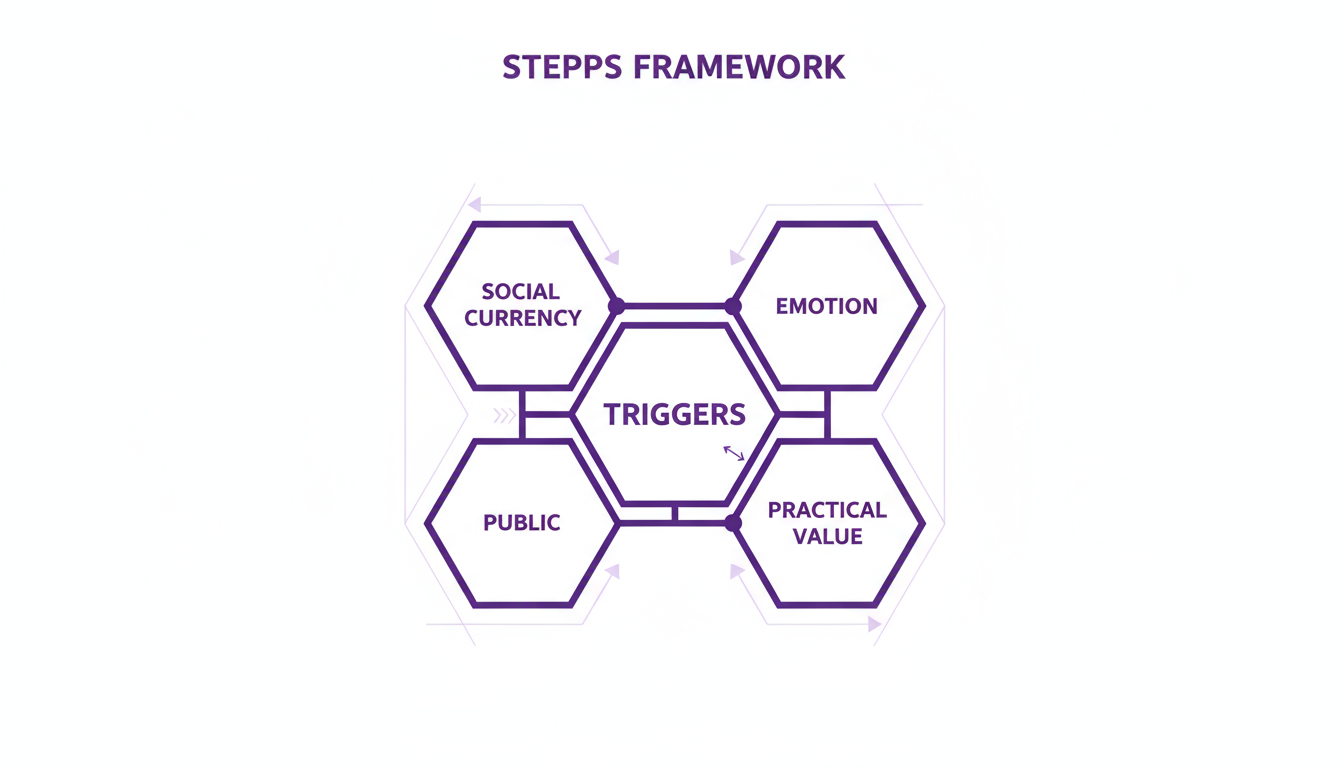
S: social currency
People share things that make them look good, smart, or in-the-know. Social currency is about status—we talk about things that enhance our self-presentation to others. Berger's research found that content conferring insider knowledge or exclusive access generates 3x more sharing than neutral content.
The Psychology: Humans are wired for social comparison (Festinger's Social Comparison Theory, 1954). We constantly evaluate how we're perceived by our peer group. Sharing something novel, impressive, or exclusive signals that we're ahead of trends, well-connected, or knowledgeable—all traits that enhance social status.
Case Study: Apple's product launches masterfully leverage social currency. Being among the first to own the latest iPhone isn't just about the device—it's a status symbol that signals you're tech-forward, financially capable, and culturally relevant. Apple doesn't need to ask customers to post unboxing videos; they design scarcity and exclusivity that makes people want to broadcast their purchase. Result: 100M+ user-generated unboxing videos without spending a dollar on referral incentives.
Application: Effective social currency in referral programs includes achievement badges, tiered access levels, exclusive communities, and public leaderboards that showcase top contributors.
T: triggers
Top of mind means tip of tongue. Triggers are environmental stimuli that remind people about your product at the right moment. Berger's research on "context-dependent recall" shows that people are far more likely to share when they encounter a relevant trigger in their environment.
The Psychology: Human memory works associatively—seeing, hearing, or experiencing one thing activates neural pathways connected to related concepts. Effective triggers create frequent, contextual reminders that prompt sharing behavior without requiring explicit recall effort.
Case Study: Rebecca Black's "Friday" became viral not just because it was memorably bad, but because it had a weekly trigger. Every Friday, millions of people were reminded of the song, re-shared it, and kept it in cultural consciousness. Similarly, Kit Kat's "break" association with coffee breaks increased sales by embedding the product into daily routines. Triggers aren't one-time events—they're recurring environmental cues.
Application: Referral programs need trigger mechanisms: milestone notifications ("You've earned 500 points—share to unlock the next tier"), countdown timers on exclusive offers, and contextual prompts tied to user behavior (completing a challenge, achieving a streak, unlocking a new feature).
E: emotion
High-arousal emotions drive sharing—whether positive (awe, excitement, humor) or negative (anger, anxiety). Content that makes people feel something intensely is content they talk about.
The Psychology: Berger's research on emotional arousal and virality found that content evoking high-arousal emotions (awe, excitement, anger, anxiety) is shared 34% more than low-arousal emotions (sadness, contentment). The key isn't just positive vs. negative—it's physiological activation. High-arousal emotions create a psychological need to share as a way of processing and connecting with others.
Case Study: Dove's "Real Beauty" campaign generated 3.8M shares in its first month by evoking awe and emotional connection. The campaign didn't ask for shares—it created profound emotional resonance that made viewers want to spread the message. Similarly, charity: water's emotionally compelling storytelling about clean water access has driven 1M+ organic shares and $70M in donations without traditional advertising.
Application: Referral programs should embed emotional experiences—collaborative challenges where teams achieve goals together, surprise-and-delight rewards that create moments of joy, and progress narratives that build anticipation and excitement. Emotion transforms referrals from mechanical transactions into shared emotional experiences.
P: public
If something is built to show, it's built to grow. The more publicly observable a behavior, the more it spreads through social proof and imitation. Berger's work on behavioral visibility shows that people are far more likely to adopt behaviors they can see others performing.
The Psychology: Robert Cialdini's social proof principle (from Influence: The Psychology of Persuasion) demonstrates that humans look to others' behavior to guide their own, especially under uncertainty. When referral participation is visible—through leaderboards, public badges, social media sharing, or observable rewards—it normalizes the behavior and encourages imitation.
Case Study: The ALS Ice Bucket Challenge succeeded because every participation was a public performance. Participants filmed themselves, tagged friends, and created a visible chain of participation. This visibility created social pressure (you were publicly nominated), social proof (everyone's doing it), and FOMO (fear of missing out). Result: $115M raised and 17M videos created in 8 weeks—all without traditional marketing spend.
Application: Make referral participation visible through public leaderboards, shareable achievement badges, social media integration that showcases participation, and visual indicators (like progress bars or tier levels) that others can see. Visibility transforms referrals from private actions into public demonstrations of engagement.
P: practical value
People share useful information that helps others. Content with clear practical value—tips, discounts, life hacks, tutorials—spreads because sharing it makes the sharer useful to their network.
The Psychology: Berger's research on "social utility theory" shows that people are motivated to share information that will benefit others in their network. This isn't pure altruism—it's social bonding. By sharing something genuinely useful, you strengthen relationships and enhance your reputation as a valuable connection.
Case Study: The New York Times' most-shared articles aren't celebrity gossip—they're practical guides on health, finance, and self-improvement. Articles with actionable advice generate 29% more shares than pure entertainment content. Similarly, Costco's sample stations don't just sell products—they provide practical value (try before buying) that customers naturally discuss and recommend to others.
Application: Two-sided referral incentives embody practical value—when both the referrer and the referred friend benefit, sharing becomes genuinely helpful rather than self-serving. Programs offering mutual rewards (storage space, account credits, premium features) give referrers social permission to share because they're providing real value to their friends.
S: stories
Information travels under the guise of idle chatter—stories are vessels for ideas. We don't share facts; we share narratives. Berger's research shows that stories are 22x more memorable than facts alone and are far more likely to be retold.
The Psychology: Humans are narrative creatures. Stories engage multiple brain regions simultaneously—language processing, sensory cortex, motor cortex (when imagining actions)—creating richer neural encoding than pure information. The "narrative transportation" effect (Green & Brock, 2000) shows that when people are absorbed in a story, they're less critical and more persuaded.
Case Study: Subway's Jared Fogle story (before his downfall) drove the brand's explosive growth in the early 2000s. The narrative—"ordinary guy loses 245 lbs eating Subway"—was so compelling that customers retold it without prompting. It wasn't just "Subway is healthy"; it was a transformation story that spread organically. Similarly, Airbnb's founding story (designers selling cereal boxes to fund the startup) became part of the brand mythology that customers love to retell.
Application: Challenge-based referral systems create built-in narratives: "I completed this quest," "Our team reached this milestone," "I unlocked this achievement." These aren't just metrics—they're story arcs that participants naturally want to share. The story carries the referral.
The Power of Combined STEPPS
The magic of STEPPS isn't in applying one principle—it's in combining multiple principles to create compound virality. Dropbox's referral program didn't just offer practical value (extra storage); it also provided social currency (power user status), triggers (storage notifications), and public visibility (shared folder invitations). That multi-layered approach is why they achieved a 0.7+ viral coefficient while competitors with simple "refer-a-friend" buttons struggled to hit 0.2.
Now let's see how these principles translate into referral program mechanics that actually work.
sTEPPS applied to referral programs: from theory to mechanics
Understanding STEPPS is one thing. Translating it into actual referral program features that drive measurable viral growth is another. Let's map each STEPPS principle to specific mechanics, explaining not just what works, but why it works from a psychological perspective.
Social currency in referral design
Mechanic: Tiered achievement systems with visible status indicators
Instead of a flat "refer a friend, get a reward" structure, effective programs create progression tiers that confer increasing status. Consider Morning Brew's 10-tier referral program: Tier 1 (3 referrals) = sticker pack; Tier 5 (25 referrals) = limited-edition hat; Tier 10 (1,000 referrals) = trip to headquarters. Each tier is publicly visible, creating a status hierarchy that gamers recognize immediately.
Why it works: Tiered systems tap into both achievement motivation (McClelland's Need for Achievement theory) and status-seeking behavior. Each tier represents visible progress toward elite status—something participants naturally want to broadcast. When someone reaches "Ambassador" tier, they're not just earning rewards; they're earning bragging rights. That status becomes its own incentive to share.
Real-world impact: Morning Brew grew from 100K to 3M subscribers primarily through referral mechanics that made participation a status symbol. Their referral conversion rate (percent of users who refer at least one person) sits at 47%—more than 3x the industry average of 15%.
Mechanic: Achievement badges and public profiles
Visible badges that appear on profiles, in community forums, or in social sharing create instant social currency. "First Referral," "10x Connector," "Viral Ambassador"—these aren't just labels; they're digital status symbols that participants display proudly.
Why it works: The endowment effect (Kahneman, Knetsch, & Thaler, 1991) shows that people value things more highly once they own them. Earning a "Viral Ambassador" badge creates ownership that participants want to showcase. Combined with the social proof principle, visible badges signal to others that referral participation is normative behavior—"everyone who's engaged has these badges."
Triggers that drive ongoing referrals
Mechanic: Milestone notifications and progress tracking
Instead of one-time referral asks, effective systems send contextual notifications tied to meaningful milestones: "You've earned 450 points—just 50 more to unlock Premium tier!" or "Your referral chain has grown to 12 people—help it reach 15 for bonus rewards!"
Why it works: The Zeigarnik Effect (1927) describes our psychological need to complete unfinished tasks. Progress bars sitting at 90% create cognitive tension that motivates action. Milestone notifications serve as triggers that bring the referral program back to top-of-mind precisely when users are close to achieving the next reward level—the moment when motivation peaks.
Real-world impact: Duolingo's streak notifications are legendary for retention—users who maintain a 7-day streak are 5x more likely to become long-term users. The same psychology applies to referral programs: progress triggers convert passive interest into active participation.
Mechanic: Contextual invite prompts
Rather than generic "Invite Friends" buttons on a settings page, effective programs surface invite opportunities in context: after completing a challenge, when unlocking a new feature, when receiving a reward, or when viewing content worth sharing.
Why it works: Implementation intentions research (Gollwitzer, 1999) shows that specificity dramatically increases follow-through. "Invite friends" is vague; "Share this challenge you just completed with friends who'd enjoy it" provides a specific action tied to an immediate experience. The user is already in an elevated emotional state (just accomplished something), making them more likely to share that positive experience.
Emotion: the fuel for viral sharing
Mechanic: Collaborative challenges and team-based goals
Moving beyond individual referrals to team challenges creates shared emotional experiences. Example: "Invite 3 friends to form a squad, complete this group challenge together, and all members unlock exclusive rewards."
Why it works: Shared emotional experiences create stronger bonds and higher motivation than individual pursuits (Reis et al., 2010). When you invite friends to collaborate rather than just "sign up," you're offering a joint adventure—something inherently more emotionally engaging. The dopamine hit from achieving a goal is amplified when shared with others, making team-based referrals feel rewarding rather than transactional.
Real-world impact: Peloton's team challenges drive 3x more referrals than individual workout completions. The emotional high of competing together creates organic word-of-mouth that doesn't require explicit asks.
Mechanic: Surprise-and-delight reward moments
Unpredictable, disproportionate rewards create emotional peaks that users want to share. Example: randomly upgrading a referral reward from 100 points to 1,000 points, or surprising top referrers with unexpected exclusive perks.
Why it works: Variable reward schedules (Skinner's operant conditioning research, 1950s) create stronger motivation than predictable rewards. Slot machines are addictive because you never know when the big payout comes. Similarly, surprise reward moments generate high-arousal positive emotions (delight, excitement) that users immediately want to tell others about. That organic sharing is far more authentic—and effective—than prompted sharing.
Public visibility: making participation observable
Mechanic: Social media integration with auto-generated share content
When users complete referral milestones or unlock achievements, offer pre-composed social media posts they can share with one click: "I just unlocked [Achievement] on [Platform]! Join me: [personalized link]"
Why it works: Reducing friction is critical (every additional step reduces conversion by ~20%), but the key insight is making the share visually compelling. Pre-composed posts with achievement graphics, progress stats, or milestone celebrations are far more likely to be shared because they make the sharer look impressive. It's social currency (making them look good) + public visibility (observable to their network) + minimal effort.
Real-world impact: Strava's activity sharing drives millions of referrals because completed workout posts are both impressive (social currency) and visually appealing (maps, stats, achievements). Users share not to recruit but to celebrate—referrals are a side effect of pride.
Mechanic: Public leaderboards with tiered recognition
Displaying top referrers on public leaderboards (with their permission) creates visible social proof and aspirational modeling. Seeing that "JaneDoe referred 47 friends" doesn't just highlight her achievement—it sets a benchmark that others try to reach.
Why it works: Social comparison theory (Festinger, 1954) explains our tendency to evaluate ourselves against others. Public leaderboards create upward social comparison—users see what's possible and adjust their own goals upward. Simultaneously, loss aversion (Kahneman & Tversky, 1979) kicks in for those already on the leaderboard: they don't want to lose their position, motivating continued engagement.
Practical value: making referrals genuinely helpful
Mechanic: Two-sided incentive structures
Both the referrer and the referred friend receive rewards (Dropbox: +500MB storage for both, Airbnb: $40 travel credit for both). This transforms referrals from self-serving to mutually beneficial.
Why it works: Reciprocity principle (Cialdini, 2006) states that people feel obligated to return favors. When you invite a friend and they get a valuable reward, you're providing genuine value rather than extracting a favor. This removes the social guilt of "asking for something" and reframes the referral as a gift—"Here's a bonus I wanted to share with you." Recipients are also more likely to convert (3-5x higher) because they're receiving immediate value rather than just being sold to.
Real-world impact: Dropbox's two-sided referral program drove 3,900% growth in 15 months, with 35% of daily signups coming from referrals at its peak. The key was making both parties feel like winners, not just the referrer.
Mechanic: Challenge invitations instead of generic signups
Rather than "Invite friends to join the platform," effective programs say "Invite friends to this specific challenge that matches their interests." The invitation isn't about your platform—it's about a specific, valuable experience the inviter thinks their friend will enjoy.
Why it works: Context-specific invitations carry far more practical value than generic platform invitations. "Join [Platform]" requires the invitee to figure out what they'll do there. "Try this challenge I just completed—it's perfect for you" provides immediate, concrete value. The psychological shift is massive: it's not recruitment; it's a personalized recommendation. Studies show context-specific invitations convert at 2.5x the rate of generic invites and produce 40% higher long-term engagement.
This is where natural referral psychology diverges from forced sharing mechanics. When platforms create experiences worth inviting specific people to—rather than generic "refer anyone" prompts—referrals become a natural extension of enjoying the product. Users aren't doing marketing labor; they're sharing experiences they genuinely believe others will value. That authenticity is what drives quality viral growth rather than empty signups.
Learn how challenge-based engagement transforms user acquisition →
Stories: building narrative into referral mechanics
Mechanic: Progress narratives and milestone storytelling
Instead of displaying dry metrics ("You've referred 5 people"), frame achievements as story arcs: "Your community is growing! From your first invite to Jane, your network has expanded to 15 active members who've completed 127 challenges together."
Why it works: Narrative framing activates different cognitive processing than statistical information. The storytelling brain (medial prefrontal cortex, hippocampus) creates richer emotional resonance and memory encoding than the analytical brain processing numbers. When users see their referral journey as a story—complete with beginnings, milestones, and ongoing growth—they're more emotionally invested in continuing that narrative arc.
Mechanic: Referral chain visualization
Showing visual maps of how referrals have spread—"You invited Alex, who invited Jordan and Sam, who together invited 8 more people"—creates a compelling narrative of impact and exponential growth.
Why it works: Humans struggle to intuitively grasp exponential growth, but visualizing referral chains makes viral multiplication tangible and exciting. Seeing that your single invite led to 20+ downstream signups creates a "founder effect" pride—you're not just a participant; you're the origin point of a growing community. That narrative is inherently shareable and motivating.
Real-world impact: PayPal's early referral program showed users their referral tree, creating visible proof of their viral impact. Users who could see their extended referral network were 4x more likely to continue actively referring compared to those who only saw direct referral counts.
The Compound Effect of STEPPS Integration
The real magic happens when multiple STEPPS principles work together. A referral program that combines social currency (status tiers), triggers (milestone notifications), emotion (collaborative challenges), public visibility (leaderboards), practical value (two-sided rewards), and stories (progress narratives) creates a self-reinforcing viral engine.
Each principle amplifies the others: status tiers create social currency that users want to make public; collaborative challenges generate emotions that feed into stories participants want to share; two-sided rewards provide practical value that reduces social guilt around sharing. This compound effect is why programs like Dropbox, Morning Brew, and Airbnb achieved viral coefficients 3-5x higher than competitors using single-dimension referral tactics.
Now let's examine the actual case studies that prove this framework works at scale.
case studies that prove It works: viral growth in action
Theory is compelling, but numbers tell the real story. Let's dissect four legendary referral programs that applied STEPPS principles to achieve viral growth—and extract the specific mechanics that drove their success.
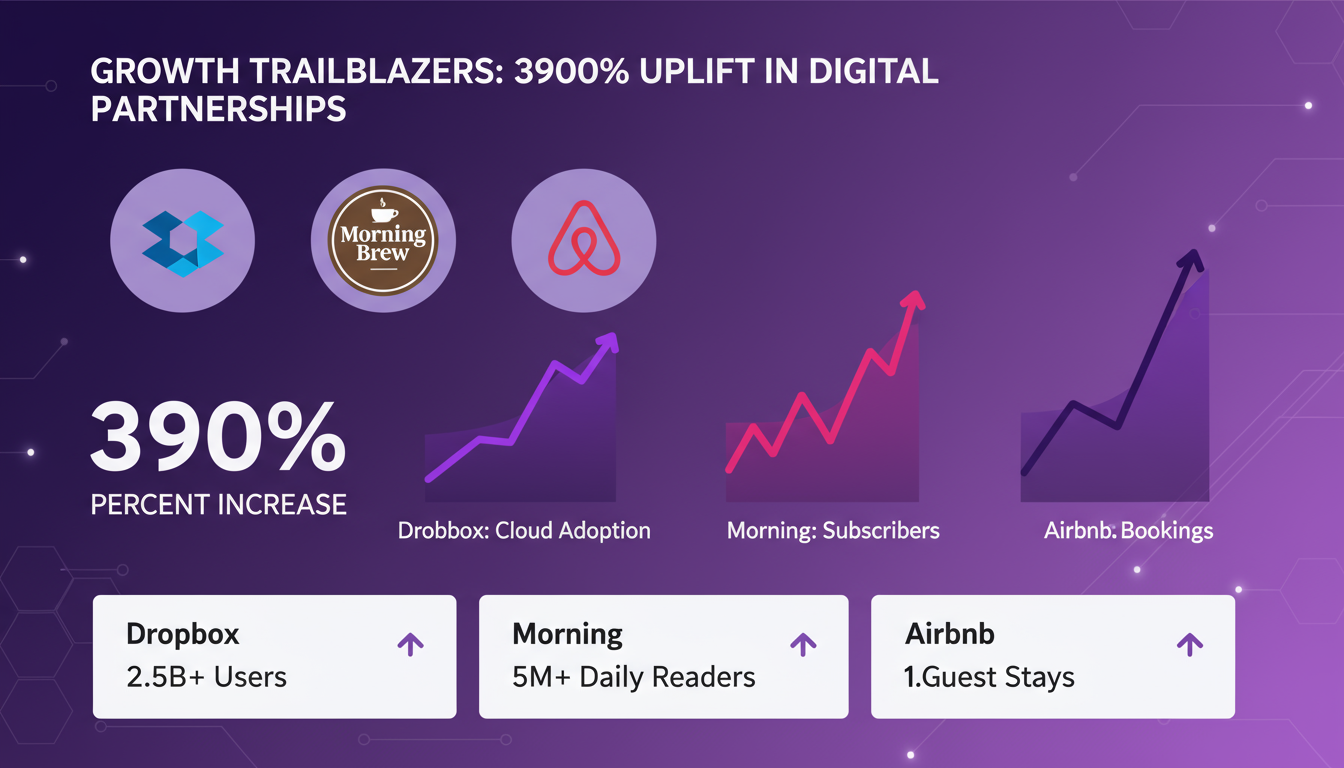
Dropbox: 3,900% growth through Storage-Based incentives
The Challenge: In 2008, Dropbox faced a classic startup dilemma—excellent product-market fit but astronomical customer acquisition costs. Traditional paid advertising was costing $233-388 per customer, making profitability impossible at scale.
The Solution: Drew Houston, Dropbox's founder, built a two-sided referral program offering 500MB of extra storage to both referrer and referee (eventually increased to 16GB cap). Users who invited friends weren't just earning rewards—they were unlocking critical storage space they genuinely needed.
STEPPS Breakdown:
- Social Currency: Power users who maxed out referral storage (16GB) achieved "pro" status without paying, signaling savvy to their network
- Triggers: Storage limit notifications reminded users they could earn more space through referrals
- Practical Value: Two-sided rewards meant inviting friends was genuinely helpful to both parties
- Public: Shared folders created visible collaboration, making Dropbox usage observable to networks
- Emotion: The satisfaction of unlocking free storage created positive reinforcement
The Results:
- Referral signups jumped from 15% to 35% of all new users within 15 months
- User base grew from 100,000 to 4,000,000 (3,900% growth)
- Viral coefficient stabilized at k = 0.7-0.9 (well above the 1.0 threshold needed for true viral growth)
- Referral program provided the same growth as $100M+ in paid advertising would have cost
Key Lesson: Dropbox succeeded because storage was genuinely valuable to both parties, the ask was specific (not generic "share our platform"), and the reward was unlimited through ongoing referrals—creating a repeatable behavior loop rather than a one-time action.
Morning brew: 3M subscribers via tiered milestone program
The Challenge: Morning Brew launched in 2015 as an email newsletter in a crowded market. They needed viral growth without advertising budget, competing against established media brands with massive marketing spend.
The Solution: Co-founder Alex Lieberman built a 10-tier referral program with escalating rewards: 3 referrals = sticker pack; 5 referrals = t-shirt; 15 referrals = mug; 25 referrals = premium hat; 50 referrals = Brew swag bag; 100 referrals = notebook; 250 referrals = backpack; 500 referrals = wine glasses; 1,000 referrals = HQ visit; 2,000 referrals = lifetime Brew merchandise. Each tier was visible, specific, and increasingly exclusive.
STEPPS Breakdown:
- Social Currency: Tiered status system created visible hierarchy; reaching "Ambassador" tier (1,000+ referrals) was a bragging right
- Triggers: Weekly newsletter served as reminder; each issue contained referral program updates
- Emotion: Unboxing physical rewards (hats, mugs) created shareable moments users posted on social media
- Public: Leaderboard showcased top referrers; recipients wore branded merchandise creating physical visibility
- Practical Value: Newsletter itself provided daily value; referring wasn't a favor—it was sharing useful content
- Stories: Progress narratives ("Sarah is 7 referrals away from her t-shirt!") created ongoing engagement
The Results:
- Referral program drove 47% of total newsletter signups
- Grew from 100,000 to 3,000,000 subscribers in 4 years (mostly organic)
- Referral conversion rate: 47% of readers referred at least one person (vs. 15% industry average)
- 30,000+ users reached tier 5 or higher, creating an army of brand ambassadors
Key Lesson: Tiered systems with tangible rewards create ongoing engagement rather than one-time referrals. Physical merchandise turned referrers into walking advertisements, amplifying public visibility. The psychology of "just one more tier" (Zeigarnik effect) kept users engaged long-term.
Airbnb: Two-Sided credits driving network effects
The Challenge: Airbnb needed to grow both supply (hosts) and demand (guests) simultaneously—a classic two-sided marketplace problem. Acquiring either side independently was expensive and inefficient.
The Solution: Airbnb launched a referral program offering travel credits to both referrer and referee: Refer a friend → both get $25-40 in travel credits. Critically, credits could be earned through either side of the marketplace: inviting guests OR inviting hosts.
STEPPS Breakdown:
- Social Currency: Being an early Airbnb user signaled worldliness, travel savviness, and cultural awareness
- Triggers: Travel planning conversations naturally prompted Airbnb mentions
- Emotion: Shared travel experiences created emotional connections users wanted to extend to friends
- Practical Value: Travel credits provided immediate, tangible value to both parties
- Stories: Travel stories inherently carry referrals—"Where did you stay?" conversations naturally led to Airbnb recommendations
The Results:
- Referral program drove 25-30% of all bookings in mature markets
- Growth rate increased 25% quarter-over-quarter after referral launch
- Two-sided credits solved the marketplace chicken-and-egg problem by incentivizing both supply and demand growth
- Users who referred were worth 2.5x more in lifetime value than non-referring users
Key Lesson: Two-sided incentives transform referrals from transactional to relational—you're giving your friend a gift (travel credit), not asking a favor. Context-aware triggers (travel conversations) made referrals natural rather than forced.
PayPal: cash incentives at scale
The Challenge: PayPal needed explosive growth to establish network effects before competitors (banks, credit cards) could respond. Every day without critical mass was a day closer to failure.
The Solution: PayPal offered $10 cash to both referrer and referee—direct cash, not platform credits. Users could refer unlimited friends and withdraw cash directly to their bank account.
STEPPS Breakdown:
- Social Currency: Early internet payments signaled tech-savviness
- Practical Value: $10 cash was unambiguous value—no terms, no limitations
- Public: Email invitations made referrals visible to networks
- Triggers: Online payment needs created natural referral moments
The Results:
- Viral coefficient reached 0.6-0.7 in peak growth months
- User base grew from 100,000 to 5,000,000 in 18 months
- Referral program cost $60-70M but delivered $2B+ in enterprise value
- After achieving critical mass, PayPal reduced incentives without killing growth (network effects had taken over)
Key Lesson: When speed is critical, direct cash incentives can jumpstart viral growth—but only if the product has genuine utility. PayPal succeeded because online payments were genuinely needed; the referral program just accelerated inevitable adoption. Once network effects kicked in, intrinsic motivation (everyone uses PayPal) replaced extrinsic incentives (cash rewards).
Common Success Patterns Across All Four
Analyzing these case studies reveals consistent patterns:
- Two-sided value: All four provided genuine value to both referrer and referee
- Specific actions: None asked generically to "share"—all tied referrals to specific contexts (storage needs, newsletter value, travel planning, payment needs)
- Ongoing engagement: Tiered systems (Morning Brew) and unlimited rewards (Dropbox, PayPal) created repeatable behaviors, not one-time actions
- Product-first: Referrals amplified existing enthusiasm; they didn't compensate for weak products
- Multiple STEPPS: Each program leveraged 3-5 STEPPS principles simultaneously, creating compound effects
The math behind these successes reveals the power of viral coefficients—let's break down the numbers.
the math of viral loops: understanding K-Factor and viral coefficients
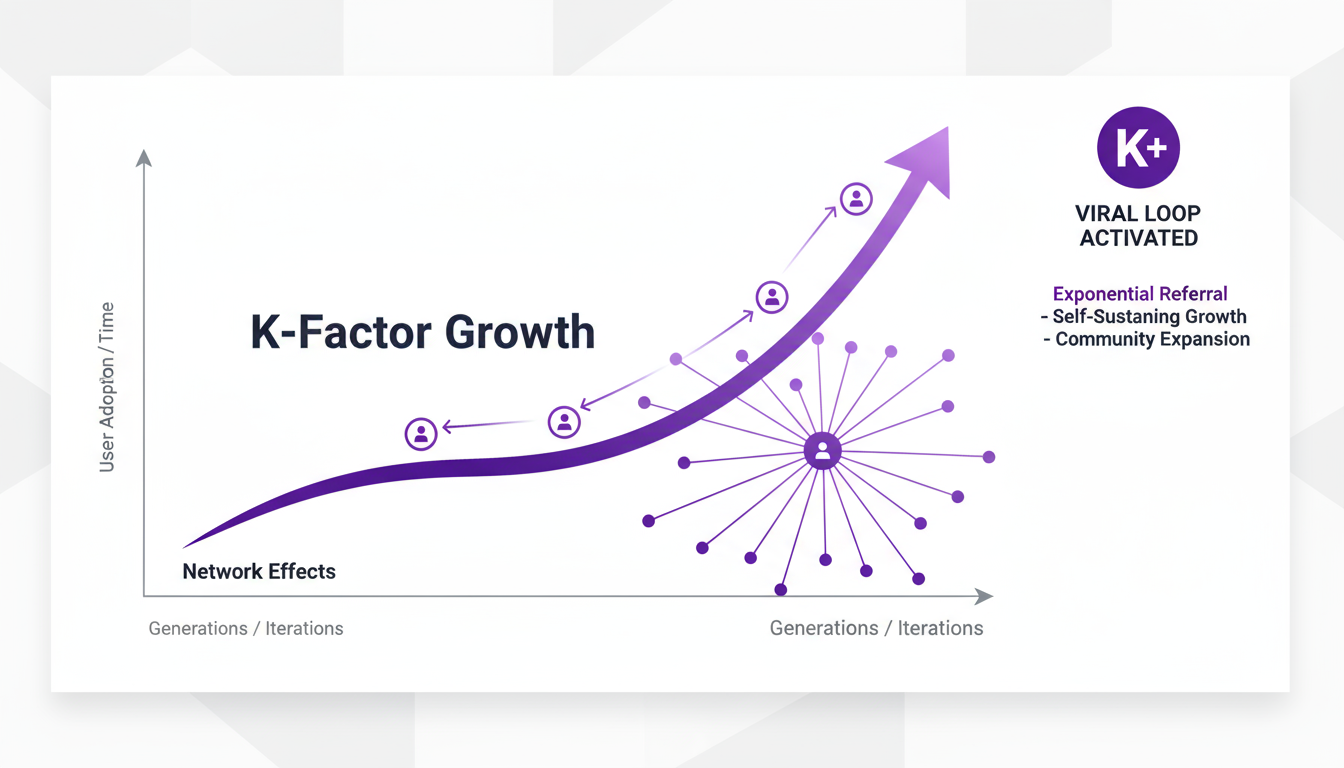
Behind every successful referral program is a simple but powerful equation that determines whether you're achieving true viral growth or just generating incremental referrals. Understanding this math is critical for designing effective referral mechanics and measuring success.
The K-Factor formula
Viral coefficient, commonly called k-factor, measures how many new users each existing user generates. The formula is elegantly simple:
k = i × c
Where:
- k = viral coefficient (new users generated per existing user)
- i = number of invitations sent per user
- c = conversion rate (percentage of invitations that result in signups)
Example: If your average user sends 5 invitations (i = 5) and 20% of invited people sign up (c = 0.20), your k-factor is 5 × 0.20 = k = 1.0
Why K-Factor matters: the viral threshold
-
k < 1.0: Sub-viral growth. Each user generates less than one new user. Growth is additive, not exponential. You'll need continued external acquisition (ads, content, PR) to maintain growth.
-
k = 1.0: Viral threshold. Each user generates exactly one new user. Growth is self-sustaining but linear. Once you stop external acquisition, growth continues at constant rate.
-
k > 1.0: True viral growth. Each user generates more than one new user. Growth is exponential. The referral program becomes a compounding growth engine that accelerates over time without additional input.
Reality Check: Very few companies achieve k > 1.0 sustainably. Dropbox reached 0.7-0.9 in peak months (exceptional); most successful referral programs stabilize at 0.3-0.5. Even at k = 0.5, you're cutting customer acquisition costs in half—a massive win.
Viral cycle time: speed of compounding
K-factor alone doesn't tell the full story—cycle time matters just as much. Viral cycle time (ct) measures how long it takes for one generation of users to invite the next generation.
Example:
- Company A: k = 0.8, cycle time = 1 week
- Company B: k = 0.5, cycle time = 1 day
Who grows faster? Company B. Despite the lower k-factor, daily compounding dramatically accelerates growth compared to weekly compounding.
Compounding Math: After 30 days with 1,000 starting users:
- Company A (k=0.8, 1-week cycles): ~3,200 users (4.3 cycles in 30 days)
- Company B (k=0.5, 1-day cycles): ~357,000 users (30 cycles in 30 days)
Shorter cycle times matter exponentially. This is why immediate rewards (Dropbox storage unlocked instantly) outperform delayed rewards (waiting weeks for approval/processing).
Benchmarking your K-Factor
Industry data from 2,000+ companies (source: Viral Loops, 2023):
Consumer Products:
- Poor: k < 0.15 (typical for generic "share" buttons)
- Average: k = 0.15-0.25 (basic referral program with incentives)
- Good: k = 0.3-0.5 (well-designed two-sided incentives)
- Excellent: k = 0.5-0.7 (STEPPS-optimized programs like Dropbox)
- Exceptional: k > 0.7 (rare; requires network effects + viral mechanics)
B2B SaaS:
- Poor: k < 0.1
- Average: k = 0.1-0.2
- Good: k = 0.25-0.4
- Excellent: k > 0.4
B2B k-factors are typically lower because:
- Smaller addressable networks (you don't refer work software to 50 friends)
- Longer decision cycles (enterprise sales involve multiple stakeholders)
- Higher consideration (business tools require more evaluation than consumer apps)
However, B2B customers have higher lifetime value, so even a k-factor of 0.3 can be extraordinarily profitable.
Optimizing the K-Factor equation
Since k = i × c, you can improve your viral coefficient by optimizing either variable:
Increasing (i) - Invitations Sent:
- Reduce friction (one-click invite vs. multi-step flows)
- Add triggers (milestone notifications, progress reminders)
- Create multiple invite opportunities (challenge completion, achievement unlocks, reward moments)
- Incentivize quantity (tiered rewards that require multiple referrals)
Increasing (c) - Conversion Rate:
- Two-sided incentives (value for both parties increases conversion)
- Social proof (show how many others have joined)
- Context-specific invitations (specific challenge invites convert better than generic platform invites)
- Frictionless onboarding (every extra step costs 20% conversion)
- Trust signals (personal invitations from friends convert 3-5x better than cold outreach)
Real-World Example: Morning Brew's referral optimization:
- Initial program: i = 2.3, c = 12% → k = 0.28
- After adding tiered rewards: i = 4.7 (users sent more invites to reach higher tiers)
- After streamlining signup flow: c = 18% (reduced friction increased conversion)
- Optimized k-factor: 4.7 × 0.18 = k = 0.85
That optimization—driven by STEPPS principles (social currency through tiers, reduced friction)—increased their k-factor by 3x, dramatically accelerating growth.
Measuring referral program ROI
K-factor tells you growth velocity, but ROI tells you financial viability:
ROI = (Referred Customer LTV × Referral Volume) - Referral Program Costs
Example:
- Customer LTV: $500
- Referral program cost per referred customer: $50 (incentive costs + program overhead)
- Monthly referred customers: 1,000
ROI = ($500 × 1,000) - ($50 × 1,000) = $450,000 net monthly value
Compare that to paid acquisition:
- Paid CAC: $250
- Customers acquired: 1,000
- Cost = $250,000 (pure expense, no revenue credit)
Referral programs not only cost less per acquisition—they generate customers with 2-3x higher retention and lifetime value because they're pre-qualified by trusted recommendations.
The compounding power of viral growth
Let's visualize exponential growth with different k-factors over 10 generations:
| Generation | k=0.3 | k=0.5 | k=0.7 | k=1.0 | k=1.2 | |------------|-------|-------|-------|-------|-------| | 0 (start) | 1,000 | 1,000 | 1,000 | 1,000 | 1,000 | | 1 | 1,300 | 1,500 | 1,700 | 2,000 | 2,200 | | 2 | 1,390 | 1,750 | 2,190 | 3,000 | 3,640 | | 3 | 1,417 | 1,875 | 2,533 | 4,000 | 6,008 | | 5 | 1,443 | 2,031 | 2,980 | 6,000 | 14,918 | | 10 | 1,474 | 2,197 | 3,581 | 11,000| 111,795 |
Notice how small k-factor improvements create massive growth differences over time. Moving from k=0.5 to k=0.7 doesn't sound dramatic, but after 10 generations it's 63% more users. Moving from k=0.7 to k=1.0 (crossing the viral threshold) doubles your user base.
Discover how engagement-driven mechanics amplify viral growth →
This is why optimizing referral programs is one of the highest-leverage growth activities. Small improvements to invitation rates or conversion rates compound exponentially over time.
Making K-Factor Actionable
Understanding viral coefficients isn't just academic—it changes how you design and optimize referral programs:
- Measure both i and c separately to know which lever to pull (more invites vs. better conversion)
- Reduce cycle time through instant rewards and frictionless flows
- Optimize for k > 0.4 as your initial target (achievable with STEPPS principles)
- Track cohort-specific k-factors (different user segments may have dramatically different viral behavior)
- Test relentlessly—A/B test invitation copy, reward structures, and trigger timing to incrementally improve both variables
The companies that achieve exceptional k-factors don't get lucky—they systematically apply STEPPS principles to maximize both invitation frequency and conversion rate. Now let's explore how focusing on quality over quantity prevents referral spam and builds sustainable growth.
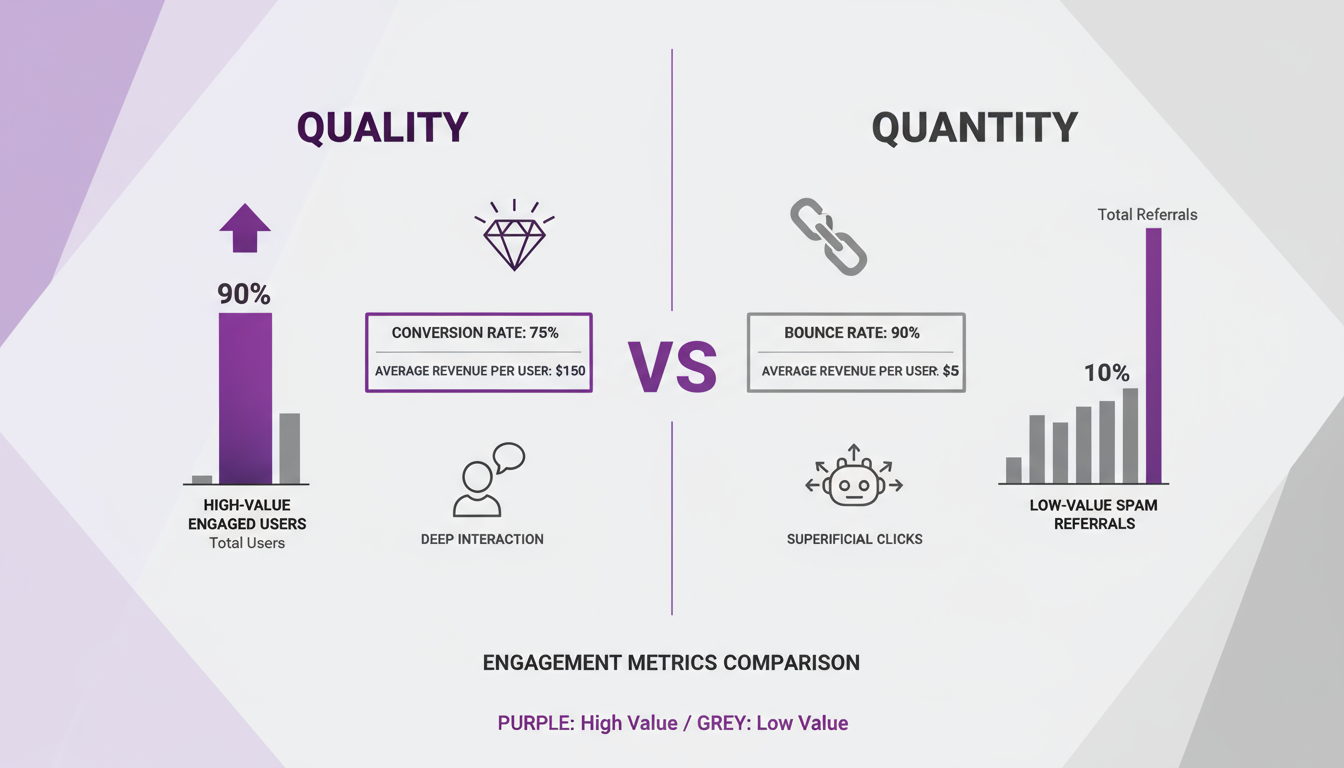
quality over quantity: building sustainable viral growth
Chasing high k-factors without regard for referral quality is a trap that's destroyed countless programs. You can inflate invitation numbers through aggressive prompts, spam-friendly mechanics, and cash incentives—but if those referrals don't convert, engage, or retain, you've built a leaky bucket that drains resources without generating sustainable growth.
The harsh reality: Low-quality referrals often cost more than they're worth. Here's why quality matters more than quantity—and how to design referral programs that prioritize engaged users over empty signups.
The hidden costs of Low-Quality referrals
Consider two hypothetical referral programs:
Program A: Quantity-Focused
- K-factor: 0.6 (looks impressive)
- Referral conversion rate: 8%
- Referred user retention (90-day): 15%
- Referred user LTV: $50
Program B: Quality-Focused
- K-factor: 0.4 (looks worse)
- Referral conversion rate: 25%
- Referred user retention (90-day): 65%
- Referred user LTV: $350
Which program is more valuable? Program B generates 7x more lifetime value per referred customer despite a lower k-factor. Why? Because retention multiplies everything. A customer who stays active for years is worth exponentially more than ten customers who sign up and churn within weeks.
The Math:
- Program A: 1,000 users → 600 referrals → 48 conversions → 7 retained = $350 total LTV
- Program B: 1,000 users → 400 referrals → 100 conversions → 65 retained = $22,750 total LTV
Program B generates 65x more value from fewer absolute referrals because quality retention compounds over time.
Why Low-Quality referrals damage brands
Beyond ROI, spam referrals actively harm your brand:
1. Reputation Damage
When users spam their entire contact list with generic invitations, recipients associate your brand with spam. Research from the Journal of Interactive Marketing found that brands associated with aggressive referral tactics experience 23% lower trust scores and 31% lower purchase intent—even among people who've never used the product.
2. Support Burden
Low-quality referrals generate disproportionate support costs. Users who sign up without genuine interest or understanding create support tickets, confused onboarding flows, and negative word-of-mouth. A single confused user can cost 10-20x more in support resources than an engaged user.
3. Network Pollution
When your referral program attracts disengaged users, it pollutes community spaces, social features, and user-generated content. This degrades the experience for high-quality users, creating a negative spiral where your best customers leave because the community feels low-quality.
4. Data Skew
Low-quality referrals distort your analytics, making it harder to understand what actually drives engagement. If 60% of your referrals churn immediately, your product metrics are dominated by users who were never genuinely interested, making it nearly impossible to optimize for the users who matter.
Designing for quality: Engagement-Based reward structures
The solution isn't to abandon referral incentives—it's to tie rewards to engagement, not just signups.
Mechanic: Two-Stage Rewards
Rather than rewarding referrals immediately upon signup, reward them upon engagement milestones:
- Stage 1: Small reward when referred friend signs up (recognition, not major incentive)
- Stage 2: Meaningful reward when referred friend completes onboarding, reaches 7-day activity, or completes first purchase
Why it works: This structure incentivizes referrers to invite people who will actually engage, not just anyone with an email address. You're rewarding quality referrals, not spam. Studies show two-stage reward structures reduce referral volume by 20-30% but increase referred user LTV by 150-200%—a massive net positive.
Example: Robinhood's referral program gives both parties a free stock only after the referred friend makes their first trade. This ensures referrals are directed toward people genuinely interested in investing, not just anyone seeking a quick signup bonus.
Mechanic: Tiered Milestone Programs
Morning Brew's 10-tier program naturally filters for quality. Getting to tier 5 (25 referrals) requires sustained effort over time—not something spammers can achieve easily. Users who reach high tiers have proven they're referring engaged readers who stick around, because churn would prevent hitting those milestones.
Why it works: Tiered systems with escalating rewards create long-term thinking. Users who want the tier 10 reward (1,000 referrals) can't spam their way there—they need to build a genuinely engaged referral network. This self-selects for quality-focused referrers.
Context-Specific invitations: the Anti-Spam design pattern
Generic "Share with Friends" buttons encourage low-quality mass sharing. Context-specific invitations encourage high-quality targeted sharing.
Generic Invitation (Low Quality): "Invite your friends to join [Platform]!"
- No context on why their friends would care
- No specificity on what friends would do
- Encourages mass email blasts
Context-Specific Invitation (High Quality): "Loved this challenge? Invite [Friend Name] who mentioned wanting to [specific interest] to try it with you!"
- Specific experience being shared
- Personalized to a particular friend's interests
- Creates a joint activity rather than solo signup
Why it works: Context-specific invitations tap into practical value (STEPPS) by making the referral genuinely useful to the recipient. The referrer thinks carefully about which friend would actually enjoy this specific experience, leading to higher conversion (the friend is pre-qualified) and higher retention (they were invited to something relevant to their interests).
Real-World Impact: Platforms using challenge-based invitations report:
- 2.5x higher conversion rates vs. generic invites
- 40% higher 30-day retention for referred users
- 67% lower spam report rates
The quality improvement comes from intentionality—users aren't mindlessly sharing; they're thoughtfully matching experiences to specific friends who'd value them.
This shift from "invite everyone" to "invite the right person to the right experience" is the future of sustainable viral growth. It aligns with STEPPS principles (stories, practical value, social currency) and builds networks of genuinely engaged users rather than inflated signup numbers that churn immediately.
Retention multipliers: why referred users stay longer
Here's a counterintuitive finding: high-quality referred users have 2-3x higher lifetime retention than users acquired through paid channels—but only if the referral program is designed for quality.
Why referred users retain better:
- Pre-qualification: Friends refer friends who are genuinely likely to enjoy the product (if the referral mechanism encourages specificity)
- Social connection: Referred users have an existing relationship with someone already using the product, creating built-in social accountability
- Trust transfer: Recommendations from trusted sources carry far more weight than advertising, leading to higher initial trust and patience during onboarding
- Network effects: If multiple friends are using the product, the value increases (this is especially powerful for social, collaborative, or multiplayer products)
The Compounding Effect:
High-retention referred users don't just stick around longer—they're also more likely to refer others, creating a positive feedback loop:
- Generation 1: You refer 5 friends
- Generation 2: Those 5 friends each refer 3 friends (15 total)
- Generation 3: Those 15 each refer 2 friends (30 total)
But this only works if each generation is high-quality. If Generation 1 churns after 2 weeks, there is no Generation 2.
Quality-focused referral programs create multi-generational referral chains because each generation is engaged enough to authentically recommend the product to their networks. This is how true viral growth happens—not through one-time spam blasts, but through sustained, authentic advocacy from genuinely satisfied users.
Anti-Spam safeguards: protecting your program
Even with quality-focused design, some users will try to game the system. Implement these safeguards:
1. Rate Limits Cap daily/weekly invitations per user (e.g., 10 invites per day max). This prevents mass email list uploads and forces more thoughtful, targeted invitations.
2. Duplicate Detection Flag and block referrals to the same email address from multiple referrers (a common fraud tactic).
3. Engagement Thresholds Require referrers to hit minimum engagement levels before unlocking referral features (e.g., must complete 3 challenges or reach 7-day activity before inviting others). This ensures only genuinely engaged users can refer.
4. Review Systems Flag referrers generating high volumes with low conversion or high churn rates. Investigate patterns and potentially restrict referral privileges for abusers.
5. Spam Reporting Give referred users an easy way to report unwanted invitations. High spam report rates should trigger automatic referrer penalties.
These safeguards protect program integrity without punishing legitimate users—they're surgical anti-abuse mechanisms that preserve quality while allowing authentic sharing.
The Quality Mindset Shift
Sustainable viral growth requires a fundamental mindset shift: prioritizing lifetime value over signup volume, engagement depth over breadth, and authentic advocacy over incentivized promotion.
The best referral programs don't feel like marketing programs at all—they feel like natural extensions of product value that make sharing inevitable, valuable, and emotionally rewarding. That's the difference between a k-factor of 0.15 (generic share buttons) and 0.7 (STEPPS-optimized viral engines).
Now let's translate this theory into an actionable implementation playbook you can apply immediately.
implementation playbook: what works, what fails, what to build
You understand STEPPS. You've seen the case studies. You know the math. Now let's get tactical: what specific features should you build, what mistakes should you avoid, and what psychological principles should guide your design decisions?
What works: the proven mechanics
1. Challenge-Based Invitations
What it is: Instead of generic "Invite Friends," users invite specific friends to specific experiences—challenges, quests, collaborative activities, or time-limited events.
Why it works:
- Practical value: You're sharing something genuinely useful ("Try this challenge with me") rather than asking a favor ("Join this platform")
- Stories: Each challenge is a narrative arc users want to share
- Social currency: Inviting someone to an exclusive or impressive challenge makes the inviter look good
- Emotion: Collaborative challenges create shared emotional experiences
Implementation:
- After challenge completion, prompt: "Know someone who'd love this challenge? Invite them to try it!"
- Create team challenges that require inviting friends to participate
- Allow users to send challenge previews (what the challenge entails, why it's interesting) rather than just generic platform links
Benchmarks: Challenge-based invitations convert at 2.5x the rate of generic invites and produce 40% higher 30-day retention.
2. Tiered Milestone Reward Systems
What it is: Multiple reward tiers with increasing value, requiring progressively more referrals (e.g., 3 referrals = small reward, 25 = medium, 100 = premium, 1,000 = exclusive access).
Why it works:
- Social currency: Each tier is a visible status symbol
- Triggers: Progress notifications create ongoing engagement
- Emotion: Anticipation of next tier drives continued participation
- Stories: Users share their progress narratives ("Just reached Ambassador tier!")
Implementation:
- Start with 5-10 tiers spanning realistic referral ranges (3 to 1,000+)
- Make tiers visible on user profiles/leaderboards
- Send progress notifications at 50%, 75%, and 90% toward next tier
- Offer mix of digital (badges, features) and physical (merchandise) rewards
Benchmarks: Tiered programs see 3x higher ongoing referral activity vs. flat reward structures.
3. Two-Sided Incentive Structures
What it is: Both referrer and referred friend receive rewards, making referrals mutually beneficial.
Why it works:
- Practical value: The referral is a gift to the friend, not just self-serving
- Reciprocity: Friends feel grateful rather than solicited
- Conversion: Pre-qualified value increases signup rates 3-5x
- Social permission: Givers feel less guilty about "asking"
Implementation:
- Offer equivalent or greater value to the referred friend (not just the referrer)
- Make the friend's reward immediate and unconditional (no hoops to jump through)
- Frame referral messaging around "I wanted to give you this" rather than "Sign up through my link"
Benchmarks: Two-sided programs achieve 3-5x higher conversion rates and 2x higher referred user LTV.
4. Social Sharing Integration with Pre-Composed Content
What it is: One-click sharing to social media with pre-written copy and visual assets that make the sharer look good.
Why it works:
- Public: Social media posts create visible participation
- Social currency: Pre-composed posts are designed to be impressive
- Friction reduction: One-click removes effort barrier
- Stories: Achievement posts carry brand referrals naturally
Implementation:
- Integrate Instagram, X, LinkedIn, TikTok, Facebook sharing APIs
- Generate visual assets (achievement graphics, stats, progress) automatically
- Pre-write engaging copy users can customize
- Embed personalized referral links in shared content
Benchmarks: Pre-composed social shares generate 8-12x more referral traffic than manual sharing prompts.
5. Progress Visualization and Referral Chain Tracking
What it is: Visual displays of referral impact—network maps showing how referrals have spread, progress bars toward milestones, and statistics on community growth generated.
Why it works:
- Emotion: Seeing your viral impact creates pride and motivation
- Stories: Referral chains become narratives ("My referrals led to 50+ signups!")
- Social currency: Impressive referral stats are worth sharing
- Triggers: Visual progress creates urgency to complete milestones
Implementation:
- Build visual referral tree/network map showing first, second, and third-generation referrals
- Display aggregate impact statistics ("Your network has completed 1,247 challenges together")
- Show real-time updates as referral chains grow
Benchmarks: Users who can visualize their referral impact refer 4x more than those who only see simple counts.
What fails: Anti-Patterns to avoid
1. Generic "Share This" Buttons Without Context
Why it fails: No emotional connection, no practical value, no story—just a transactional ask that triggers psychological resistance. These convert at <1% and generate mostly spam referrals.
Fix: Replace with context-specific invitations tied to experiences users just completed or are currently enjoying.
2. Cash-Only Incentives Without Social/Emotional Components
Why it fails: Pure cash rewards frame referrals as mercenary acts, reducing authenticity and trust. They work for initial growth spurts (see PayPal) but don't create sustainable advocacy.
Fix: Combine cash/credit incentives with social currency elements (tiers, badges, recognition) and emotional experiences (collaborative challenges, surprise rewards).
3. One-Time Rewards (No Ongoing Engagement)
Why it fails: After users claim their single reward, motivation evaporates. There's no incentive for ongoing referral activity.
Fix: Implement tiered milestone systems with unlimited upside or regenerating rewards (e.g., "Earn rewards every 5 referrals").
4. Delayed or Complicated Reward Fulfillment
Why it fails: Delayed rewards reduce motivation (hyperbolic discounting—we value immediate rewards far more than delayed ones). Complicated redemption processes create friction and abandonment.
Fix: Deliver rewards instantly upon qualification. Automate fulfillment completely. Minimize steps between referral and reward.
5. Ignoring Referral Quality (Rewarding Signups Regardless of Engagement)
Why it fails: Incentivizes spam, degrades community quality, inflates metrics with disengaged users who never convert to value.
Fix: Implement two-stage rewards tied to engagement milestones (reward when referred friend completes onboarding or hits 7-day activity, not just signup).
6. No Social Proof or Visibility
Why it fails: Without seeing others participate, users assume referral programs aren't worth engaging with. Invisible programs generate minimal participation.
Fix: Add public leaderboards, showcase top referrers, display "X people have invited friends this week" social proof, integrate referral achievements into user profiles.
Technical requirements: what you need to build
Core Infrastructure:
- Unique Referral Links: Generate unique tracking codes for each user (e.g.,
app.com/ref/USER123) - Attribution System: Track referral sources through cookies, URL parameters, and database associations
- Reward Engine: Automated system for detecting qualified referrals and distributing rewards
- Fraud Detection: Rate limits, duplicate email detection, engagement threshold checks
- Analytics Dashboard: Track k-factor, conversion rates, cycle time, LTV by cohort
Integration Points:
- Social Media APIs: Instagram, Facebook, X, LinkedIn, TikTok for one-click sharing
- Email/SMS: Invitation delivery systems
- CRM Integration: Sync referral data to Salesforce, HubSpot, etc. for sales/marketing alignment
- Payment Processing: Automate cash/credit reward fulfillment
- Notification Systems: Milestone alerts, progress updates, achievement unlocks
UX Considerations:
- Onboarding Integration: Introduce referral program naturally during user activation (not immediately, but after first value moment)
- Contextual Prompts: Surface invite opportunities at high-engagement moments
- Mobile Optimization: 60%+ of referrals happen on mobile—optimize flows accordingly
- Copy Testing: A/B test invitation messaging, reward framing, and call-to-action copy
- Friction Audits: Measure drop-off at each step and ruthlessly eliminate unnecessary clicks
Psychology layer: stepps in every Decision
As you build, constantly ask:
- Social Currency: Does this make users look good to their peers?
- Triggers: What reminds users to refer at optimal moments?
- Emotion: What emotional experiences make sharing feel rewarding?
- Public: How can we make participation visible and observable?
- Practical Value: Is this genuinely useful to both referrer and referee?
- Stories: What narratives are we enabling users to share?
Every feature decision should map to at least 2-3 STEPPS principles. Single-dimension features (e.g., just practical value without social currency or emotion) will underperform multi-dimensional features that layer multiple principles.
Launch and iteration strategy
Phase 1: MVP (Months 1-2)
- Build basic unique link generation and attribution
- Implement simple two-sided reward structure
- Add contextual invite prompts (post-challenge, post-achievement)
- Launch with 20% of users to test mechanics
Phase 2: Optimization (Months 3-4)
- Analyze k-factor, conversion rates, referred user LTV
- A/B test reward amounts, messaging, timing
- Add social sharing integration
- Expand to 50% of users
Phase 3: Scaling (Months 5-6)
- Implement tiered milestone system
- Add public leaderboards and achievement visibility
- Build referral chain visualization
- Launch to 100% of users
Phase 4: Sophistication (Months 7+)
- Implement two-stage engagement-based rewards
- Add fraud detection and anti-spam safeguards
- Build segment-specific referral strategies (different approaches for power users vs. casual users)
- Optimize for multi-generational referral chains
Measurement Discipline:
Track weekly:
- K-factor (overall and by cohort)
- Invitation volume per user
- Conversion rate
- Viral cycle time
- Referred user retention (7-day, 30-day, 90-day)
- Referral ROI (LTV vs. incentive costs)
Set targets and iterate relentlessly. A 10% improvement in conversion rate or invitation volume compounds to massive growth differences over time.
The Build vs. Buy Decision
Building a sophisticated referral system in-house requires significant engineering resources—4-6 months for a full-featured system. Alternatively, modern platforms with built-in referral mechanics let you apply STEPPS principles without building infrastructure from scratch.
The key is ensuring whatever solution you choose supports:
- Context-specific invitations (not just generic sharing)
- Multi-platform social integration
- Tiered reward structures
- Two-sided incentives
- Quality-focused engagement tracking
Whether you build or buy, the STEPPS framework remains your design compass—prioritize features that deliver social currency, triggers, emotion, public visibility, practical value, and stories.
Now let's look at where referral marketing is headed.
the future of referral marketing: trends and predictions
The referral marketing landscape is evolving rapidly, driven by changing consumer psychology, technological capabilities, and economic pressures. Here's where the industry is headed—and what you need to prepare for.
1. Context-Aware sharing replaces generic prompts
The Shift: Static "Share with Friends" buttons are dying. The future is dynamic, context-aware invitations that surface at psychologically optimal moments based on user behavior, emotional state, and social context.
Technology Enablers:
- AI-powered timing optimization (machine learning models that predict when users are most likely to share)
- Behavioral triggers based on micro-interactions (detecting moments of delight, achievement, or surprise)
- Social graph analysis (understanding which friends are most likely to be interested based on demonstrated preferences)
Example: Imagine completing a fitness challenge and immediately seeing: "Your friend Sarah just completed a similar running challenge—invite her to join you for the advanced version!" The system knows Sarah's interests, recent activity, and relationship strength with you, making the invitation highly relevant and likely to convert.
Why it matters: Context-aware invitations will increase conversion rates 3-5x over static prompts while dramatically reducing spam. Users won't feel bombarded—they'll encounter perfectly timed opportunities that feel natural rather than forced.
2. collaborative mechanics over individual rewards
The Shift: Future referral programs will emphasize team-based challenges, collaborative goals, and network effects over individual "refer and earn" mechanics.
Psychology: Humans are tribal creatures. Research on collective action and group identity shows that collaborative goals create stronger motivation, higher engagement, and more authentic advocacy than individual incentives. When you invite friends to join a team challenge rather than just "sign up," you're offering connection and shared experience—far more motivating than isolated rewards.
Example: Instead of "Refer 10 friends, earn $50," imagine "Form a 5-person squad, complete challenges together, and all members unlock exclusive rewards plus team leaderboard recognition." The referral becomes the means to a collaborative goal rather than the end itself.
Network Effects Amplification: Collaborative mechanics create network effects where the product becomes more valuable as more friends join. This is especially powerful for community-driven platforms, multiplayer experiences, and social products where value scales with network size.
Prediction: By 2027, collaborative referral mechanics will outperform individual incentive programs by 2-3x in both conversion rates and referred user retention. The future is "invite your tribe" not "invite individuals."
This evolution aligns perfectly with modern community engagement platforms that treat referrals not as isolated transactions but as network expansion—building interconnected communities rather than collecting individual signups. When platforms enable rich collaborative experiences worth inviting friends into (rather than just generic "join this app" asks), referrals become natural byproducts of social interaction.
The companies that will dominate referral marketing in the next decade are those building products so inherently social and collaborative that inviting friends isn't a separate "referral action"—it's how you engage with the product itself. Multi-sided challenge systems, team progression mechanics, and social achievement structures make referrals inevitable because isolation isn't an option; the product is designed for groups.
This shift requires rethinking referral program infrastructure. Instead of tracking "User A referred User B," future systems track "User A invited Users B, C, D, and E to Squad 1, which collectively completed Challenge X and unlocked Reward Y." The attribution becomes network-based rather than individual-based, and rewards flow to the collective rather than just the referrer.
3. CAC inflation forces organic growth prioritization
The Trend: Customer acquisition costs have increased 60% over five years, with no signs of slowing. Paid advertising is becoming prohibitively expensive for all but the most high-LTV products. Median SaaS CAC payback periods now stretch to 23 months—dangerously long for startups burning cash.
The Response: Companies are shifting growth budgets from paid acquisition to organic growth engines—referral programs, content marketing, community building, and product-led growth. Referral programs delivering $6.50 return per dollar spent dramatically outperform paid channels struggling with 2-3x CAC increases year-over-year.
Strategic Implication: Referral programs are no longer "nice-to-have" growth supplements—they're becoming core growth engines for companies serious about sustainable unit economics. Expect to see:
- VP of Referral Growth roles emerging (dedicated executives owning viral loop optimization)
- Referral program budgets shifting from 5-10% of growth spend to 30-40%
- Product roadmaps prioritizing referral mechanics as core features, not afterthoughts
Prediction: By 2026, companies with k-factors above 0.4 will have 3-5x lower CAC than competitors relying on paid acquisition, creating massive competitive advantages in customer acquisition efficiency.
4. the Anti-Spam movement
The Backlash: Consumers are increasingly fatigued by aggressive referral prompts, inbox spam from referral programs, and social media feeds clogged with incentivized sharing. Platform algorithms (Instagram, Facebook, LinkedIn) are downranking content identified as referral spam, reducing organic reach.
The Correction: Quality-focused referral programs with strong anti-spam safeguards will thrive; quantity-focused programs will see declining performance as platform algorithms penalize them and consumers tune them out.
Features of Anti-Spam Design:
- Engagement-based rewards (not just signup-based)
- Rate limits and invitation caps
- Context-specific invitations (not broadcast spam)
- Easy spam reporting for recipients
- Penalties for referrers generating high spam complaint rates
Prediction: Platforms that don't prioritize anti-spam safeguards will see their referral programs become net-negative for brand reputation by 2026. Conversely, programs designed around quality and authenticity will see increasing effectiveness as consumers trust them more.
5. Psychology-First platforms win
The Divide: The referral marketing landscape is splitting into two camps:
- Feature-first platforms: Focus on technical capabilities (tracking, attribution, reward delivery) without psychological depth
- Psychology-first platforms: Build STEPPS principles, behavioral science, and emotional design into core product architecture
The Winner: Psychology-first platforms will dominate because they produce 3-5x better results. Companies are realizing that technical infrastructure is table stakes—the differentiator is how well the platform applies behavioral science to drive natural sharing behavior.
What Psychology-First Looks Like:
- Challenge-based invitations (stories + practical value)
- Tiered achievement systems (social currency + triggers)
- Collaborative mechanics (emotion + public visibility)
- Multi-platform social sharing (public + social currency)
- Referral chain visualization (stories + emotion)
- Engagement-based rewards (quality + practical value)
Prediction: By 2027, the market will consolidate around platforms that demonstrably understand and apply behavioral psychology, while generic "add a referral link" solutions become commoditized and lose market share.
Preparing for the Future
To stay ahead:
- Invest in behavioral expertise: Hire growth PMs with psychology backgrounds or partner with behavioral science consultants
- Build for quality, not just quantity: Implement anti-spam safeguards and engagement-based rewards now
- Prioritize collaborative mechanics: Design team-based challenges and network-effect features
- Optimize for context: Develop dynamic, behavior-triggered invitation systems
- Track quality metrics: Measure referred user LTV, retention, and engagement—not just referral volume
The companies that win the next decade of growth will be those treating referral programs not as marketing tactics but as core product experiences designed around human psychology, authentic advocacy, and community building.
And that brings us full circle to the Referral Paradox: stop asking customers to share. Start building experiences so engaging, emotionally rewarding, and socially valuable that sharing becomes inevitable.
conclusion: stop asking, start designing
We opened with the 54-point Referral Paradox—83% of customers willing to refer, but only 29% actually doing so. Now you understand why: explicit asks kill virality by triggering psychological resistance, transforming authentic enthusiasm into transactional obligation.
The solution isn't better incentives or more aggressive prompts. It's designing systems where sharing feels natural, valuable, and emotionally rewarding. Jonah Berger's STEPPS framework provides the blueprint:
- Social Currency: Make participants look good through status tiers, achievements, and exclusive access
- Triggers: Create environmental reminders through milestone notifications, progress bars, and contextual prompts
- Emotion: Build high-arousal emotional experiences through collaborative challenges, surprise rewards, and shared victories
- Public: Make participation visible through leaderboards, social sharing, and achievement displays
- Practical Value: Offer genuine mutual benefit through two-sided incentives and helpful invitations
- Stories: Enable compelling narratives through challenge-based invitations, referral chain visualization, and progress arcs
The case studies prove it works: Dropbox's 3,900% growth, Morning Brew's 3M subscribers, Airbnb's marketplace dominance, and PayPal's explosive scaling—all driven by referral programs applying multiple STEPPS principles simultaneously.
The math reveals the leverage: even modest k-factor improvements (from 0.3 to 0.5) compound into exponential growth differences over time. Optimizing invitation frequency and conversion rate isn't incremental—it's multiplicative.
The quality imperative shows the path forward: prioritize engaged, high-retention referrals over inflated signup numbers. Two-stage rewards, engagement thresholds, and context-specific invitations build sustainable viral growth rather than leaky buckets of churn.
And the future demands evolution: context-aware invitations, collaborative mechanics, anti-spam design, and psychology-first platforms will separate winners from losers as CAC inflation makes organic growth non-negotiable.
The Action Plan:
If you're building or optimizing a referral program:
- Audit against STEPPS: Map your current mechanics to each principle—which are you leveraging, which are missing?
- Measure your k-factor: Calculate k = i × c and benchmark against industry standards
- Prioritize quality: Implement engagement-based rewards and anti-spam safeguards
- Design for context: Replace generic prompts with challenge-based, experience-specific invitations
- Layer multiple principles: Combine social currency + triggers + emotion + public visibility for compound effects
- Iterate relentlessly: A/B test messaging, timing, rewards, and flows to incrementally improve both invitation volume and conversion rate
The Referral Paradox isn't a problem to solve—it's a symptom of poorly designed systems that fight human psychology instead of harnessing it. When you stop asking customers to share and start designing experiences that make sharing inevitable, the 54-point gap closes. Intention converts to action. Viral coefficients rise. Customer acquisition costs plummet.
The question isn't whether referral programs work—it's whether yours applies the behavioral science that separates the 0.15 k-factor failures from the 0.7+ viral success stories.
Ready to transform your user acquisition from transactional asks into natural viral growth? Explore how challenge-based referral mechanics build sustainable community engagement →
Or get started designing your STEPPS-optimized referral program today.
The 67% of virality you're currently losing isn't gone forever—it's waiting for you to stop asking and start designing.