
The Psychology of Status: Why 41% of Purchases Are for Social Signaling (Not Function)
$4.5 trillion. That's how much consumers spend annually on products purchased primarily to signal social status—not for their functional value. According to McKinsey's 2024 research, 41% of all purchases are driven by social signaling rather than utility. That luxury handbag? The premium membership? You're not buying performance. You're buying a signal.
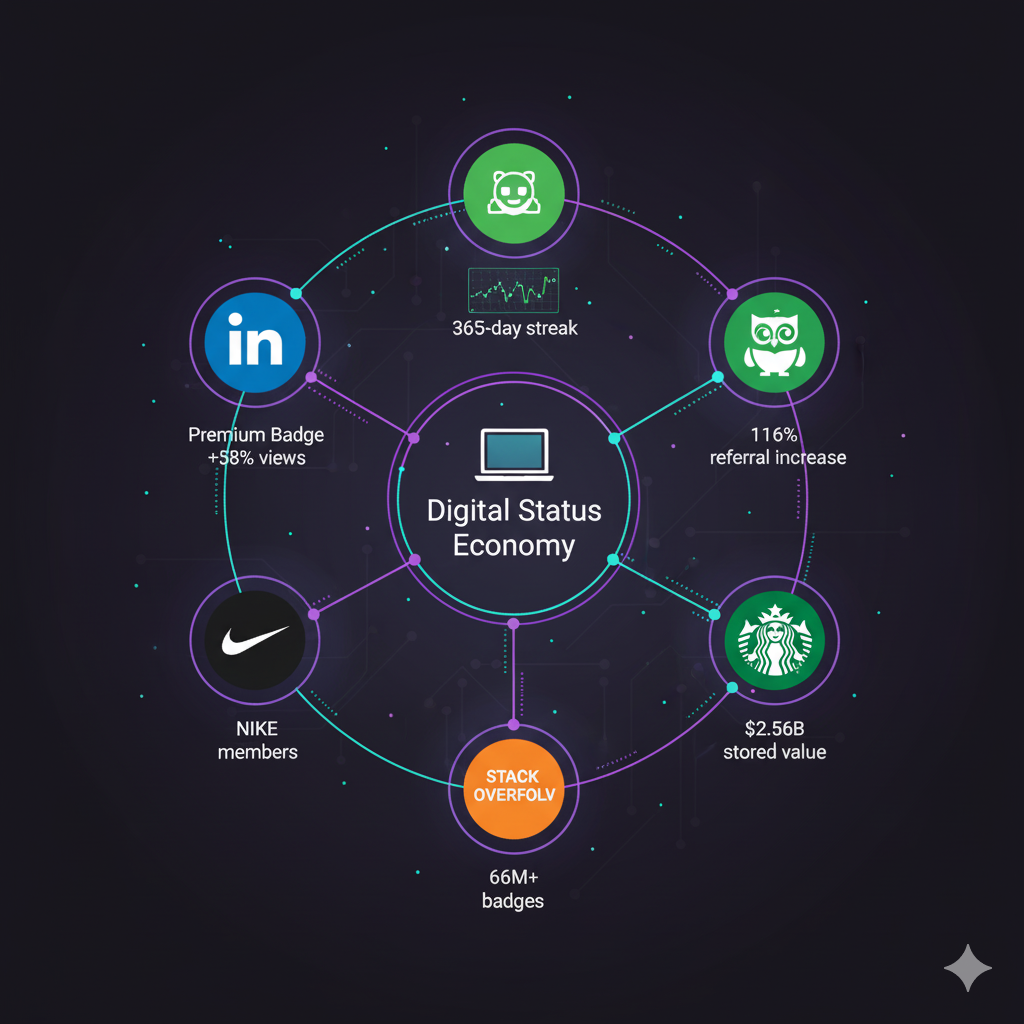
But here's what's fascinating: While physical status symbols shift toward "quiet luxury," digital status symbols are exploding. The digital badge market is projected to reach $410 million by 2029, with 83% of employers using badges for credentialing. LinkedIn premium badges, GitHub contribution graphs, Duolingo streaks, and VIP tiers have become the modern equivalent of luxury watches.
The brands that understand this psychology dominate. Sephora's Beauty Insider achieves 81% retention (versus 25% industry average) from 34 million members driving 80% of transactions. Starbucks Rewards commands 44% retention from 31 million members generating 57% of sales. Nike's digital membership grew to 160 million members representing 40% of total revenue.
These aren't accidents. They're the result of engineering status psychology into every interaction—transforming customers into status seekers who voluntarily increase spending to maintain their position in the social hierarchy.
the science of status signaling
In 1899, economist Thorstein Veblen introduced "conspicuous consumption"—wealthy individuals purchasing expensive goods not for utility, but to publicly display economic power. Writing during America's Gilded Age (Rockefeller's gold-plated doorknobs, $350,000 dinner parties), Veblen identified "Veblen goods" where demand increases as price increases.
"A $5,000 handbag signals: 'I have resources so abundant that I can allocate them to non-functional decoration.' The higher the cost, the more credible the signal."
Biologist Amotz Zahavi (1975) explained why with the Handicap Principle: A peacock's elaborate tail is metabolically expensive and hinders escape from predators—yet attracts mates because it's an honest signal of genetic fitness. "I can survive despite this massive disadvantage."
Robert Cialdini's research on social proof (1984) reveals humans are wired to follow social hierarchies. When 93% of consumers rely on reviews and 81% of purchasing decisions are influenced by social media, we're watching social proof and status seeking combine in real-time.
Daniel Kahneman's work on loss aversion (2002 Nobel Prize) shows people fear losing status more than gaining it. Research proves consumers increase spending 37% to maintain VIP tier status rather than accept demotion. The pain of losing Sephora VIB Rouge is psychologically more intense than achieving it.
This cocktail of evolutionary biology, behavioral economics, and social psychology creates the foundation for modern status-driven loyalty programs.
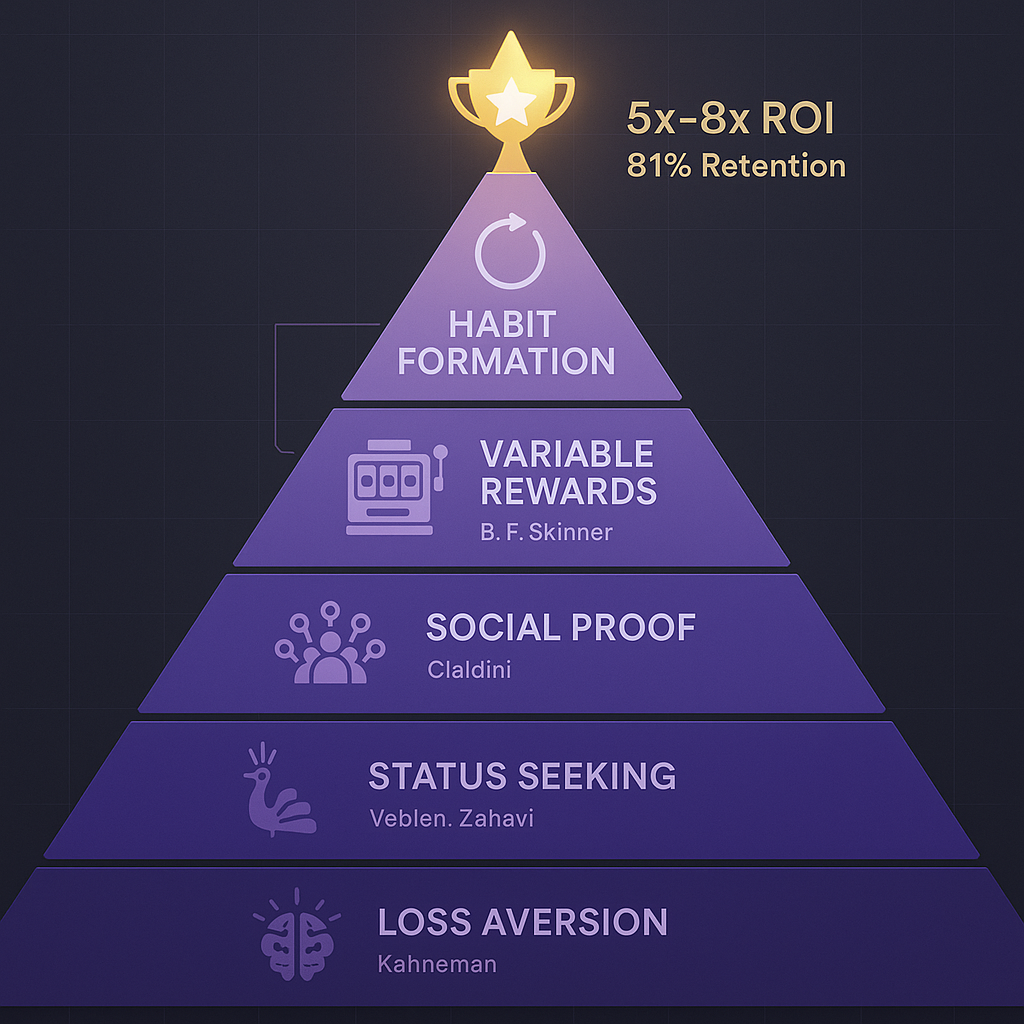
case study: how three brands engineer status
Sephora: the loss aversion architecture
Sephora's Beauty Insider features four tiers: Beauty Insider (free) → VIB ($350+) → Rouge ($1,000+) → Rouge Rewards Bazaar (experiential).
Results: 81% retention (vs. 25% average), 34 million members, 80% of transactions from members. VIB/Rouge tiers spend 15-25% more annually.
The Psychology Stack:
- Loss Aversion: Tier-at-risk emails ("You're $50 away from losing Rouge") drive 37% to increase spending. Kahneman's research: losses feel 2x more painful than gains feel pleasurable. That $50 email feels like losing $100 in benefits.
- Status Seeking: $1,000+ Rouge requirement = costly signal of resources + brand loyalty (Veblen + Zahavi).
- Social Proof: Members share tier achievements on social media, creating aspirational hierarchies.
- Variable Rewards: Rouge Rewards Bazaar offers limited experiential rewards (exclusive events, influencer meet-and-greets) creating scarcity and unpredictability.
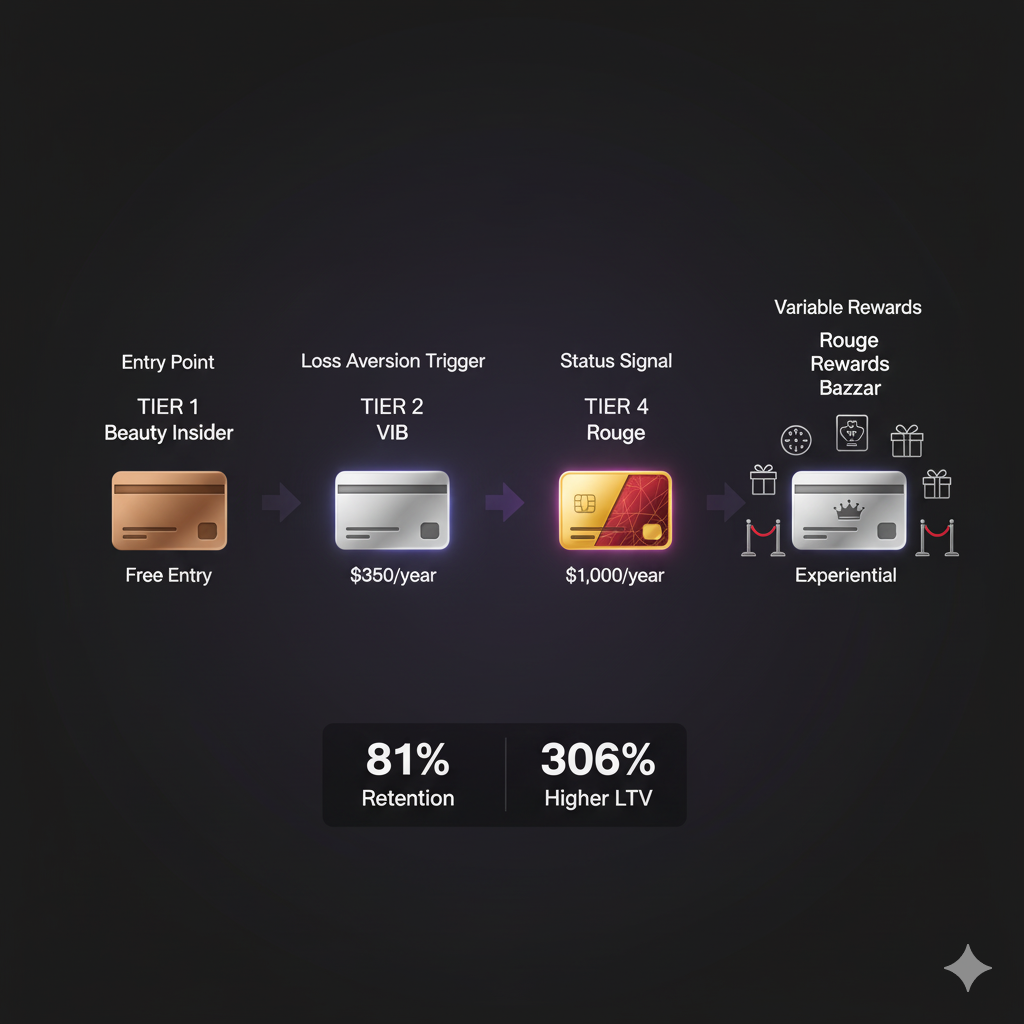
"Sephora's Beauty Insider members generate 306% higher customer lifetime value. That's not incremental improvement. That's behavioral architecture driving exponential returns."
Starbucks: gamifying the coffee run
With 31 million members and 57% of company sales from rewards members, Starbucks transformed commodity coffee into a status game.
Key Mechanism: Time-limited challenges ("Earn 50 bonus stars by purchasing 3 drinks this week") create urgency and loss aversion.
Results Post-2019 Transformation: 44% retention (vs. 22% QSR average), 7% same-store sales increase, $2.56 billion in stored value on cards.
The Psychology: Progress toward goals triggers dopamine (Stanford's Brian Knutson). "250/300 stars to Gold" creates the Zeigarnik Effect—psychological tension to complete unfinished tasks. Starbucks transformed coffee runs into psychological quests.
nike: building the 160-Million-Member status community
Nike's digital transformation created 160 million members representing 40% of revenue. Key mechanisms:
- Achievement Badges: Publicly displayed on profiles, creating visible hierarchies
- Multi-Tier Leaderboards: Weekly leagues with promotion/relegation (like European soccer) ensure everyone competes in their bracket—47% engagement increase (Stanford)
- Exclusive Access: Top-tier members get early sneaker drop access, transforming commodity athletic wear into Veblen goods
Results: Digital members have 3x higher LTV and 70% higher retention. Direct-to-consumer digital revenue grew from 15% (2017) to 40% (2024).
See how brands implement behavioral psychology at scale with tiered rewards and gamification systems proven to drive 5x+ ROI.
digital status economies: from LinkedIn to github
Professional platforms built entire economies around status signaling through digital credentials and reputation systems.
Gen Z Paradox: McKinsey shows Gen Z values "being offline" as status (control, boundaries), yet Ball State found Gen Z earned 300,000+ digital achievements (83% said badges increased motivation). The resolution? Digital status signals earned competence (expertise, discipline) rather than purchased resources (wealth). A 365-day GitHub streak signals discipline, not expenditure. Gen Z rejects purchased status but embraces earned status.
LinkedIn: Premium badges receive 2.3x more InMail responses and 58% more profile views (Wharton)—pure status signaling delivering professional advantage.
GitHub: Contribution graphs (365-day streaks) serve as digital peacock tails—costly signals requiring daily discipline demonstrating dedication.
Stack Overflow: 66 million+ badges create explicit status hierarchies. Top-ranked users receive deference, job offers, speaking invitations based purely on digital reputation.
"Status symbols don't need to be expensive—they need to be visible, scarce, and socially valued. A GitHub contribution graph costs nothing to display but signals expertise."
Duolingo: Users with 7-day streaks have 2.1x higher retention. After introducing streak notifications ("Don't lose your 47-day streak!"), Duolingo saw 116% increase in referrals and 34% increase in daily active users.
product design applications
saaS onboarding: progress bars + badges
Problem: 70-80% of users abandon during onboarding.
Solution: Progress bars with tiered badges (Beginner → Intermediate → Expert).
Results: 50% higher completion rates, 30% higher activation. Users share "I'm now an Expert user!" creating organic marketing.
fitness apps: Multi-Tier leaderboards
Problem: Single-tier leaderboards demotivate bottom 90%.
Solution: Multi-tier systems (Legend/Elite/Expert/Intermediate/Beginner) + streak tracking.
Results: Peloton reports 89% annual retention. Stanford confirms: properly designed leaderboards increase engagement 47%, but poorly designed decrease it 23%.
e-Commerce: vip tiers
Problem: CAC increased 60% in five years (Profitwell, 2024).
Solution: Silver ($250+) → Gold ($750+) → Platinum ($2,000+) with escalating benefits (free shipping, early access, experiential rewards).
Results: Tiered programs achieve 1.8x higher ROI (Forrester). Top-tier members spend 60% more annually. 90% of premium brands now offer tiered programs—it's table stakes.
when status psychology fails
Foursquare's Mayor System: User base collapsed from 50M to 10M (80% decline) because badges signaled only check-in frequency—no meaningful achievement. Deci and Ryan's Self-Determination Theory explains: humans need autonomy, competence, and relatedness. Extrinsic-only rewards fail when novelty wears off.
Lesson: Status symbols must signal earned achievement, not mechanical repetition.
Dark Patterns: Princeton found 85,000+ dark patterns in mobile games. While driving short-term engagement, they create user resentment and regulatory scrutiny (EU Digital Services Act bans manipulative patterns—fines up to 6% of global revenue).
Lesson: Ethical design respects user autonomy. Warn about genuine losses without manipulation.
strategic implications
1. Gamification Is Now Infrastructure: Market valued at $20.84B (2025) projected to $190.87B (2034) at 27.9% CAGR. Over 70% of Global 2000 companies adopted gamification.
2. Retention Is the New Growth: With CAC up 60% in five years, retention is critical. Increasing retention 5% increases profits 25-95% (Harvard Business Review). Sephora's 81% vs. 25% average isn't luck—it's behavioral infrastructure.
3. Experiential Beats Transactional: 77% of transactional programs fail within 2 years, while 90% of experiential programs report positive ROI (4.8x average). Discounts erode margins. Experiential rewards create emotional loyalty without margin erosion.
4. The Designer Knowledge Gap: 82% of designers lack behavioral psychology training (Nielsen Norman Group). Companies addressing this gap see 14% higher retention (Google).
conclusion: building status into your product
The $4.5 trillion spent on status-signaling isn't irrational—it's deeply human. From Veblen's conspicuous consumption to Kahneman's loss aversion, status seeking is hardwired into human psychology.
Winning brands engineer these principles into digital experiences:
- Tiered membership systems leveraging loss aversion and status seeking
- Badge and achievement systems creating visible, shareable status symbols
- Multi-tier leaderboards driving competitive engagement without toxic comparison
- Analytics systems measuring which status signals drive retention and revenue
- Ethical design respecting user autonomy while optimizing engagement
"The difference between a 25% retention rate and an 81% retention rate isn't magic. It's behavioral architecture—the intentional design of status hierarchies, loss aversion triggers, and social proof mechanisms."
The question isn't whether to implement status psychology—your competitors already are. The question is: Will you implement it with behavioral rigor that generates 5x-8x ROI, or add shallow gamification users ignore?
Of course, implementing status psychology requires the right infrastructure and ethical framework. Ready to engineer status psychology into your product? Explore Nudj's gamification platform to implement the same status psychology that powers billion-dollar loyalty programs—or book a 15-minute demo to see status economies in action with your specific use case.
Sources:
- McKinsey & Company. (2024). "Consumer Behavior and Status Signaling in Luxury Goods."
- Veblen, T. (1899). The Theory of the Leisure Class. Macmillan.
- Zahavi, A. (1975). "Mate Selection—A Selection for a Handicap." Journal of Theoretical Biology.
- Cialdini, R. (1984). Influence: The Psychology of Persuasion. HarperCollins.
- Kahneman, D., & Tversky, A. (1979). "Prospect Theory: An Analysis of Decision under Risk." Econometrica.
- Harvard Business Review. (2024). "The Value of Increasing Customer Retention Rates."
- Forrester Research. (2024). "The State of Loyalty Programs."
- Bond Brand Loyalty. (2024). "The Loyalty Report."
- Stanford Persuasive Technology Lab. (2023). "Behavior Design in Digital Products."
- Deci, E. L., & Ryan, R. M. (2000). "Self-Determination Theory and the Facilitation of Intrinsic Motivation." American Psychologist.
- Nielsen Norman Group. (2023). "The Designer Knowledge Gap in Behavioral Psychology."
- Ball State University. (2022). "Digital Badge Impact Study: Student Motivation and Achievement."
- Profitwell. (2024). "Customer Acquisition Cost Benchmarks."